
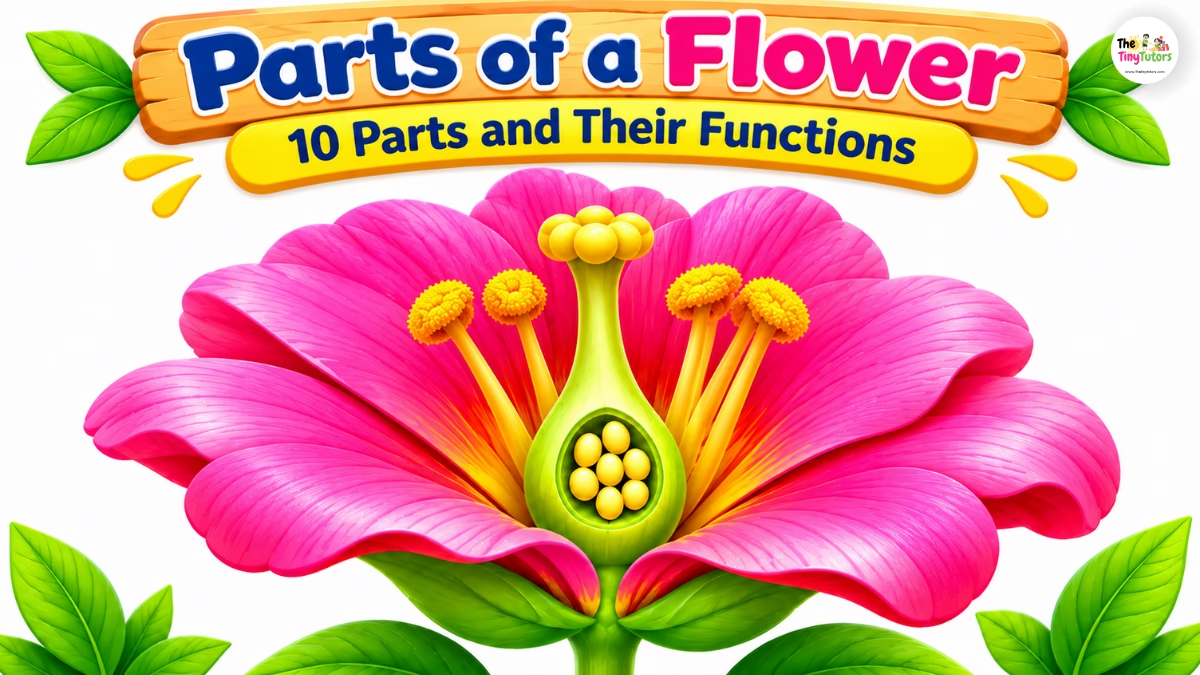
Flowers are beautiful parts of plants. They come in different colours, shapes, and sizes. Some flowers are big and bright, while others are small and delicate. But did you know that every part of a flower has a special job?
- What Is a Flower?
- What Are the Main Parts of a Flower?
- 10 Parts of a Flower and Their Functions
- Male and Female Parts of a Flower
- How Does a Flower Make Seeds?
- How Do Bees Help Flowers?
- What Happens to a Flower After Pollination?
- Do All Flowers Have the Same Parts?
- Interesting Facts About Flowers
- Simple Flower Learning Activity
- Frequently Asked Questions About Parts of a Flower
- Conclusion
- Related Articles
Some parts protect the flower before it opens, some attract bees and butterflies, and others help the plant make seeds. Each part works together to help a flowering plant grow and reproduce.
Let’s explore the parts of a flower and their functions in simple words. Children can learn the names of different flower parts, understand what they do, and discover how new plants begin to grow.
What Is a Flower?
A flower is the part of a flowering plant that helps it make seeds. It usually grows on a stem and may have colourful petals, small green sepals, and other important parts.
Flowers come in many beautiful colours, including red, yellow, pink, purple, orange, and white. Some have a sweet smell, while others have little or no fragrance.
Here are some common examples of flowers:
- Rose: A popular flower with beautiful, soft petals.
- Sunflower: A large yellow flower with a dark or yellow centre.
- Tulip: A colourful flower with cup-shaped petals.
- Daisy: A flower with a round centre and narrow petals.
- Hibiscus: A bright flower with large petals and a long central part.
Flowers are not just beautiful to look at. They also provide food, such as nectar and pollen, for bees, butterflies, and other pollinators. Most importantly, they help flowering plants produce seeds that can grow into new plants.
What Are the Main Parts of a Flower?
A typical flower has four main groups of parts. These are petals, sepals, stamen, and pistil. Each group has a different job.
- Petals: The colourful parts that attract bees, butterflies, and other pollinators.
- Sepals: The small, leaf-like parts that protect a flower when it is still a bud.
- Stamen: The male part of a flower that produces pollen.
- Pistil: The female part of a flower that contains the ovary and ovules.
The stamen and pistil have smaller parts that help them do their jobs. Let’s learn about all 10 commonly taught flower parts.
10 Parts of a Flower and Their Functions
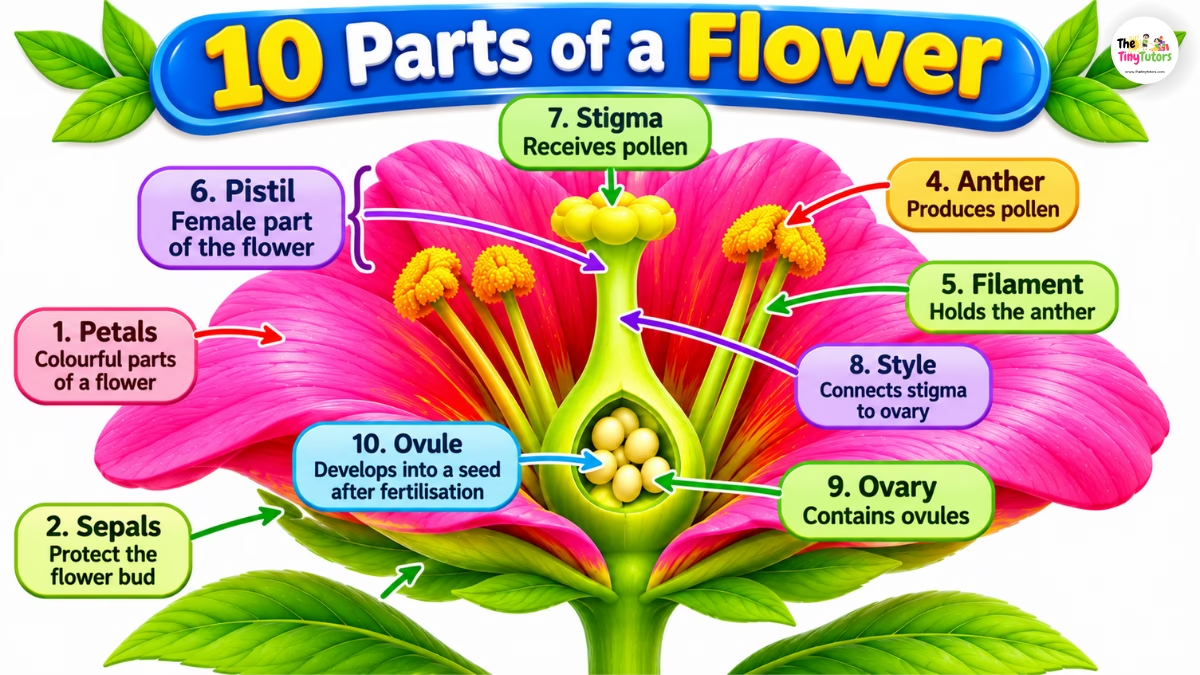
A flower has different parts that work together to protect it, attract pollinators, and help it make seeds. Here are 10 important flower parts and their functions.
1. Petals
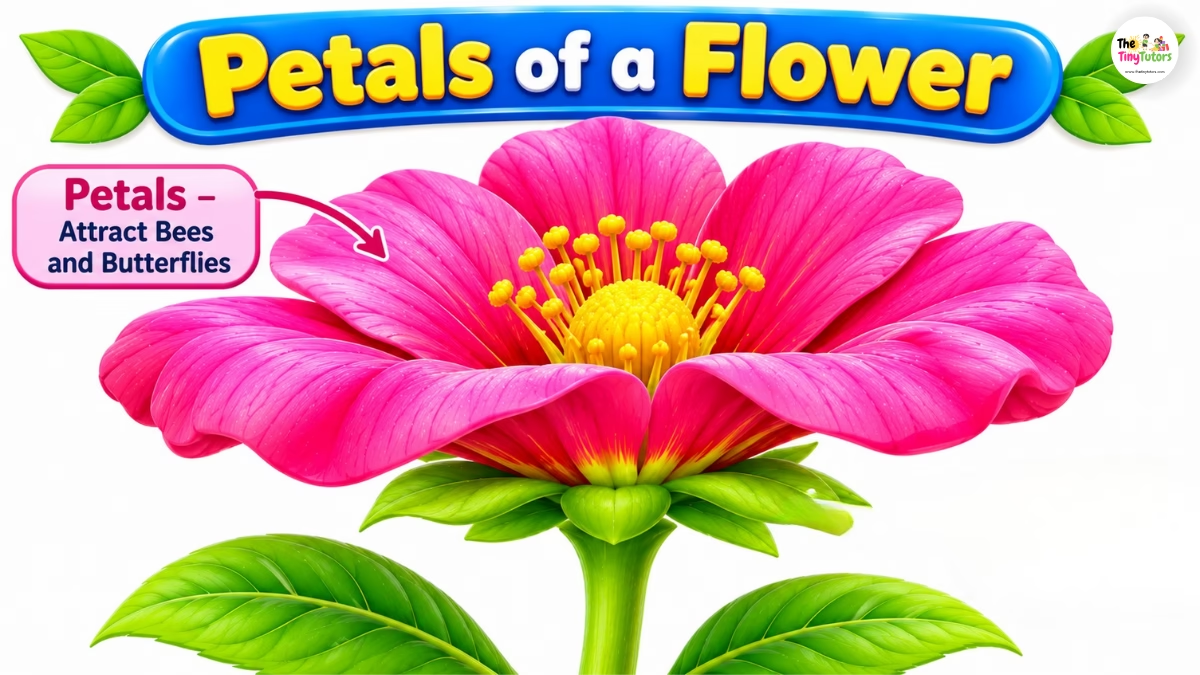
Petals are the colourful parts of a flower that surround its centre. They can be red, yellow, pink, purple, white, or many other colours. Some flowers have large petals, while others have small ones.
Have you ever noticed how bees and butterflies visit colourful flowers? Petals help attract these visitors with their bright colours and sometimes sweet smells. When insects visit flowers to collect nectar, pollen may stick to their bodies and move to another flower.
Functions of Petals:
- Attract bees, butterflies, and other pollinators.
- Help insects find flowers.
- Make flowers colourful and attractive.
- Sometimes help protect the inner parts of a flower.
2. Sepals
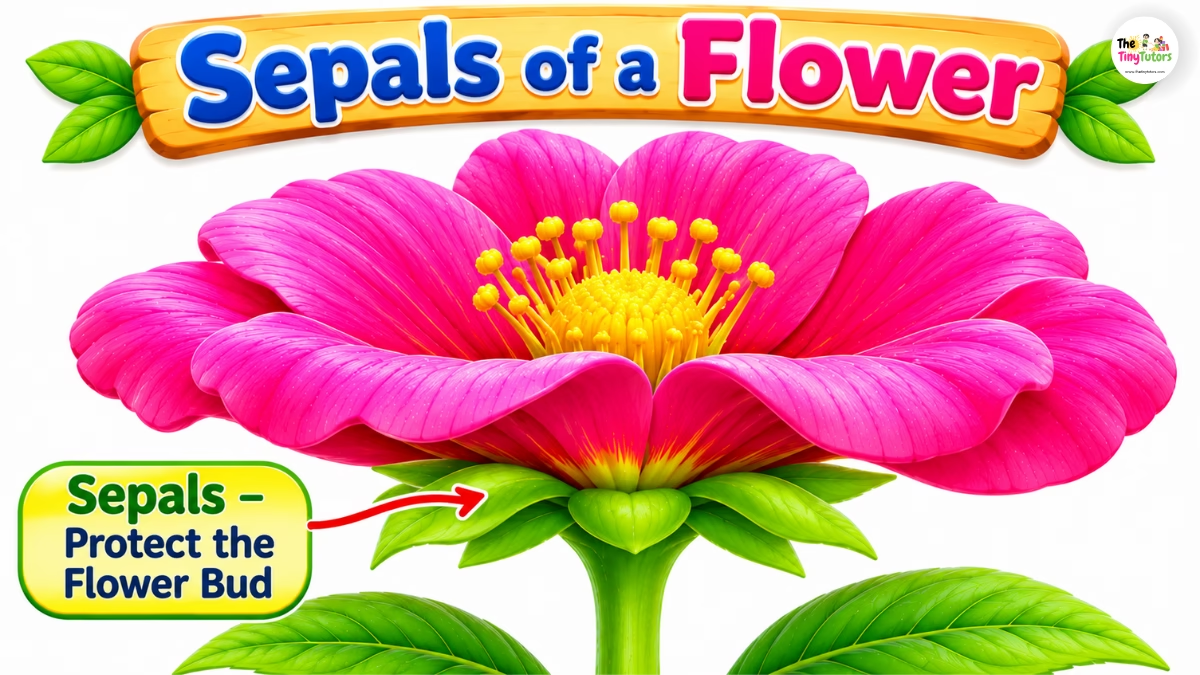
Sepals are small, leaf-like parts found at the base of a flower. They are usually green and look a little like tiny leaves. You can find them just below the petals.
Before a flower opens, it stays inside a small structure called a flower bud. Sepals cover and protect this bud while it grows. When the flower opens, the sepals usually remain underneath the petals.
Not all sepals are green. In some flowers, they can also be colourful.
Functions of Sepals:
- Protect the flower when it is still a bud.
- Help support the flower after it opens.
- Protect the growing flower from damage.
3. Stamen
The stamen is the male part of a flower. Its main job is to make pollen, which is needed for the plant to produce seeds.
You can usually find several stamens around the centre of a flower. Each stamen has two smaller parts: the anther and the filament.
The anther makes pollen, while the filament holds the anther up. Together, these two parts help the flower produce and release pollen.
Functions of Stamen:
- Produces pollen.
- Helps make pollen available for pollination.
- Plays an important role in making seeds.
4. Anther
The anther is the top part of the stamen. It is usually found at the end of a thin stalk called the filament.
Anthers are often yellow or orange, but their colours can be different in different flowers. They produce tiny grains of pollen that may look like fine yellow dust.
When a bee visits a flower, some pollen can stick to its body. The bee may then carry this pollen to another flower.
Functions of Anther:
- Makes tiny grains of pollen.
- Releases pollen when it is ready.
- Provides pollen needed for plant reproduction.
5. Filament
The filament is a thin, stem-like part of the stamen. It holds the anther at its top and gives it support.
Think of the filament as a tiny stand that holds the anther in the right position. This helps pollen become easier to reach for visiting insects or to be carried away by the wind.
Different flowers can have filaments of different lengths and shapes.
Functions of Filament:
- Supports the anther.
- Holds the anther in position.
- Helps make pollen available for pollination.
6. Pistil
The pistil is the female part of a flower. It is usually found near the centre and contains the parts that help the flower make seeds.
A typical pistil has three main parts: the stigma, style, and ovary. Each part has a special job.
The stigma receives pollen, the style connects the stigma to the ovary, and the ovary contains tiny structures called ovules. After successful fertilisation, the ovules can develop into seeds.
Functions of Pistil:
- Receives pollen.
- Contains the ovary and ovules.
- Helps the flower produce seeds.
- Plays an important role in plant reproduction.
7. Stigma
The stigma is the top part of the pistil. It is the place where pollen lands during pollination.
In many flowers, the stigma has a sticky surface that helps catch and hold pollen grains. Its shape can be different in different flowers. Some stigmas are round, while others have several small branches.
After compatible pollen reaches the stigma, it can begin to grow a tiny tube towards the ovary.
Functions of Stigma:
- Receives pollen grains.
- Helps catch and hold pollen.
- Provides a place for pollen to begin growing.
8. Style
The style is a thin, tube-like part that connects the stigma to the ovary. It is usually found in the middle of the pistil.
When pollen lands on the stigma, a tiny structure called a pollen tube can grow down through the style towards an ovule inside the ovary.
You can think of the style as a pathway that connects the top and bottom parts of the pistil.
Functions of Style:
- Connects the stigma to the ovary.
- Provides a pathway for the pollen tube.
- Helps the male reproductive cell reach an ovule.
9. Ovary
The ovary is the lower part of the pistil. It is usually found near the base of the flower and contains one or more tiny structures called ovules.
After successful fertilisation, the ovules can develop into seeds. In many flowering plants, the ovary also grows and becomes a fruit.
For example, flowers on tomato and apple plants can develop into tomatoes and apples after successful reproduction.
Functions of Ovary:
- Holds and protects the ovules.
- Provides a place where seeds begin to develop.
- Develops into a fruit in many flowering plants.
Function of Ovary:
- Holds and protects the ovules.
- Supports seed development.
- Develops into a fruit in many flowering plants.
10. Ovule
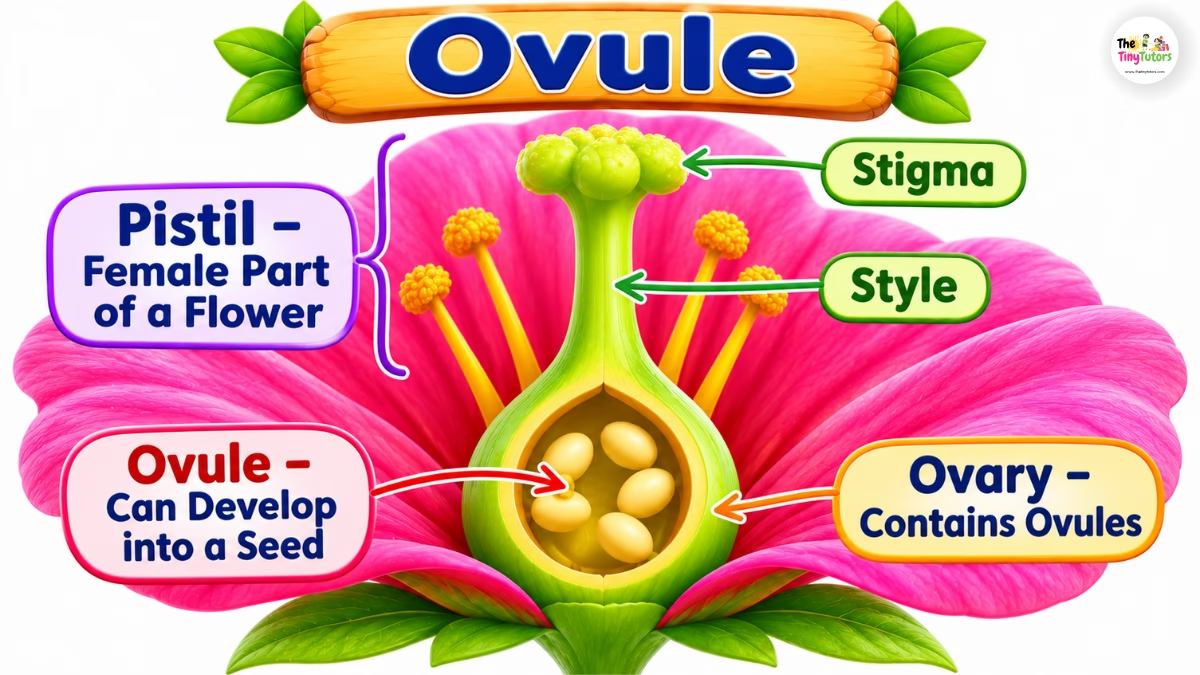
Ovules are tiny structures found inside the ovary. They contain the female reproductive cells needed for fertilisation.
When the male reproductive cell reaches an ovule and fertilisation takes place, that ovule can develop into a seed.
A seed contains a tiny baby plant called an embryo, along with stored food and a protective covering. Under suitable conditions, it can germinate and grow into a new plant.
Function of Ovule:
- Contains the female reproductive cell.
- Takes part in fertilisation.
- Develops into a seed after successful fertilisation.
Male and Female Parts of a Flower
A typical flower has both male and female reproductive parts. These parts work together to help the plant produce seeds.
Male Part – Stamen
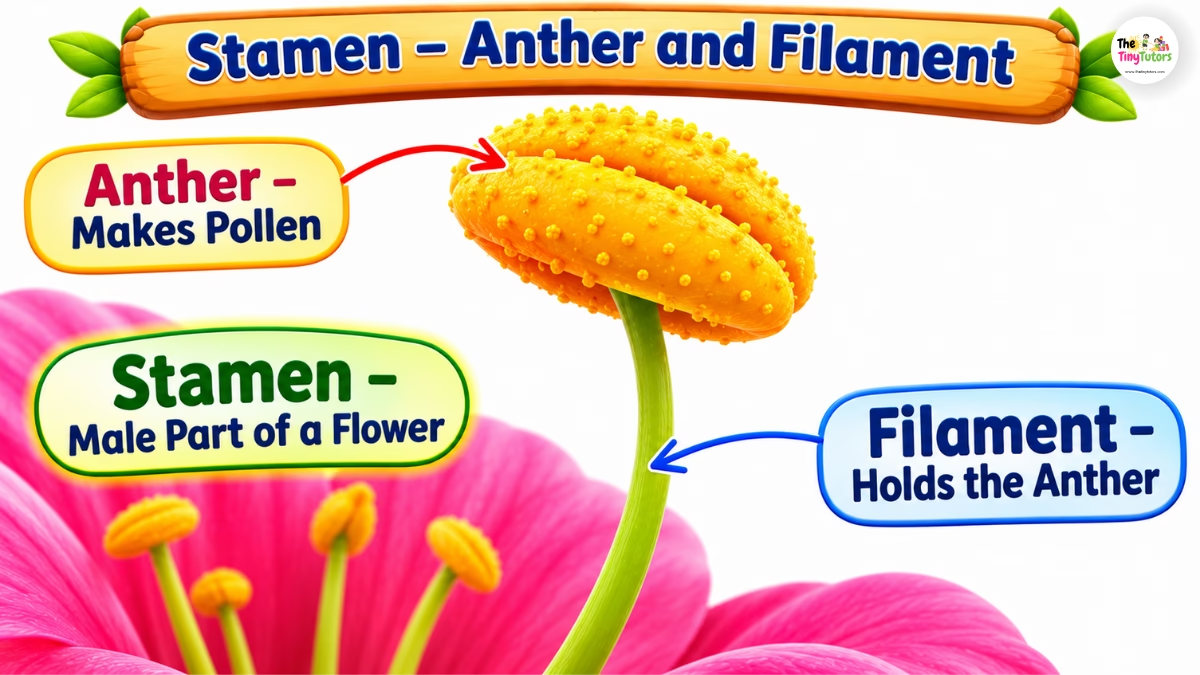
The stamen is the male reproductive part of a flower. It produces pollen grains that contain the male reproductive cells.
It has two parts:
- Anther: Produces and releases pollen.
- Filament: Supports the anther.
Female Part – Pistil
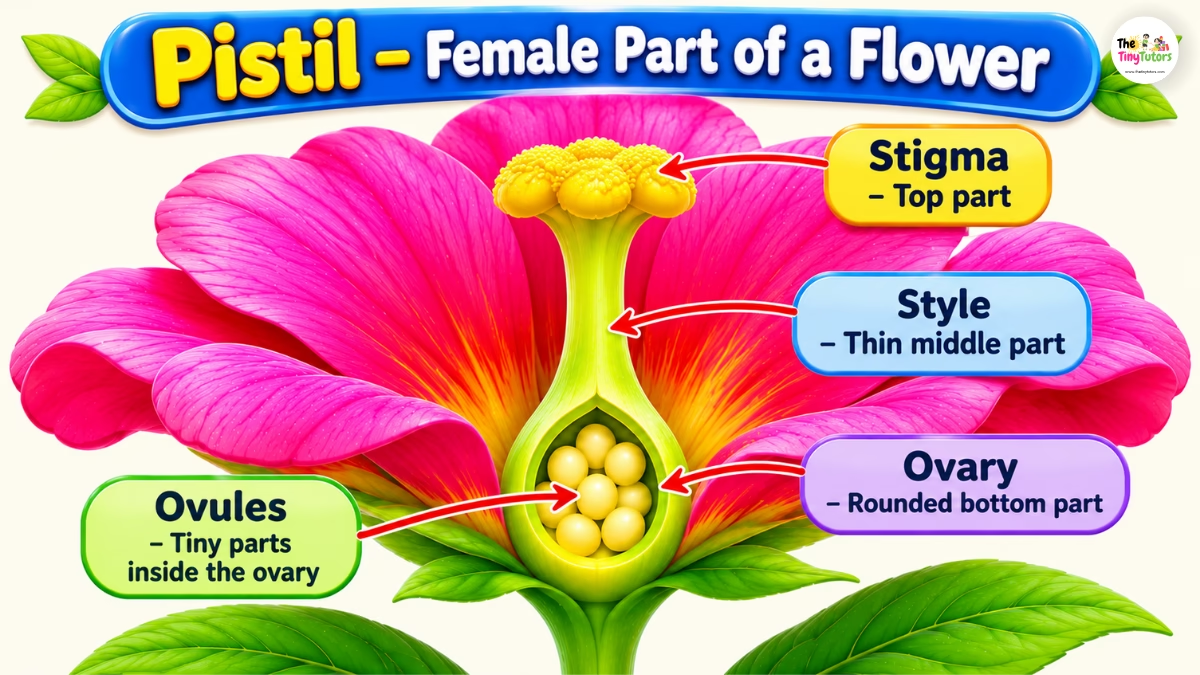
The pistil is the female reproductive part of a flower. It receives pollen and contains the ovules where fertilisation can take place.
It has three main parts:
- Stigma: Receives pollen.
- Style: Connects the stigma to the ovary.
- Ovary: Contains the ovules.
In many flowers, both the stamen and pistil are present in the same flower. However, some flowers have only male or only female reproductive parts.
How Does a Flower Make Seeds?
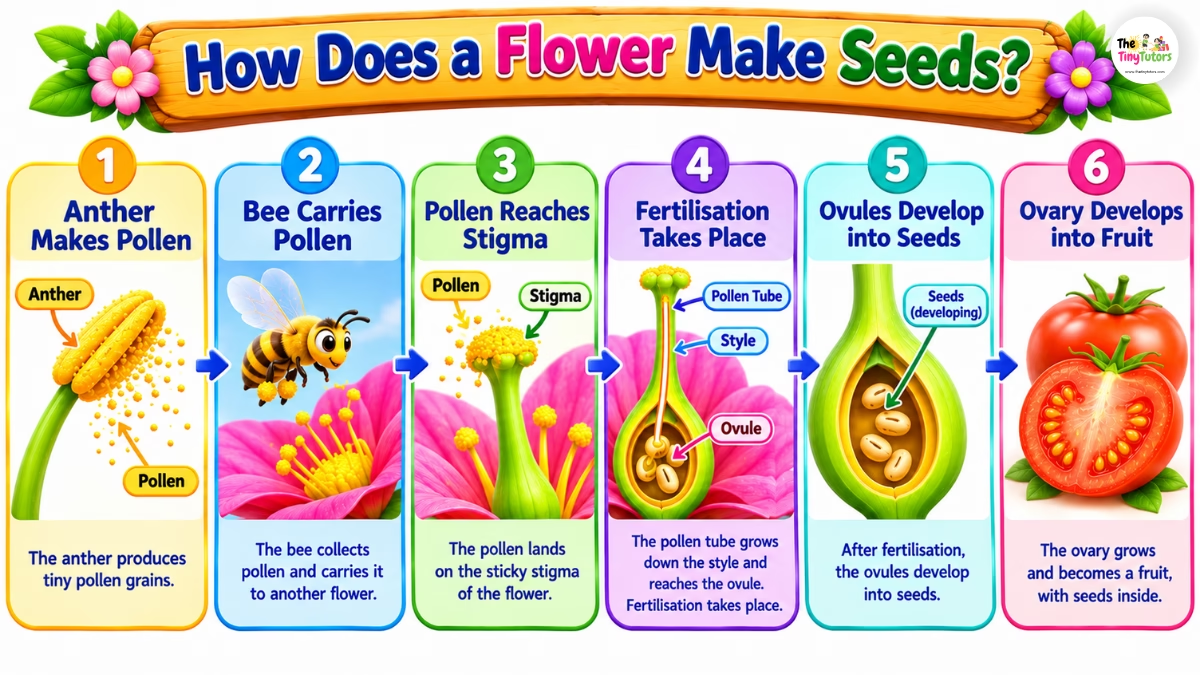
Flowers help flowering plants produce seeds through a process called reproduction. Pollination and fertilisation are two important steps in this process.
Here is how a flower makes seeds:
- Pollen Production: The anther produces tiny grains of pollen.
- Pollination: Pollen moves from the anther to the stigma of the same flower or another flower of the same species.
- Pollen Tube Formation: A pollen grain can grow a tiny tube through the style towards an ovule.
- Fertilisation: The male reproductive cell travels through the pollen tube and joins with the female reproductive cell inside the ovule.
- Seed Formation: After fertilisation, the ovule develops into a seed.
- Fruit Formation: In many flowering plants, the ovary develops into a fruit that contains the seeds.
When these seeds get suitable conditions such as water, air, and warmth, they can germinate and grow into new plants.
How Do Bees Help Flowers?
Bees play an important role in helping many flowering plants reproduce. When a bee visits a flower, it collects nectar, a sweet liquid that provides food.
While moving around the flower, pollen grains from the anther may stick to the bee’s body. When the bee visits another flower of the same species, some pollen may reach its stigma.
This movement of pollen is called pollination.
Bees are important pollinators, but they are not the only ones. Butterflies, moths, birds, bats, and even wind help transfer pollen in different plants.
Pollination allows many flowering plants to produce seeds and fruits.
What Happens to a Flower After Pollination?
After successful pollination, several changes can take place inside a flower.
- A pollen grain on the stigma may grow a pollen tube.
- The pollen tube travels through the style towards an ovule.
- Fertilisation takes place when the male reproductive cell joins with the female reproductive cell.
- The fertilised ovule develops into a seed.
- In many plants, the ovary develops into a fruit.
As the fruit grows, some of the flower’s other parts may dry up and fall off. The seeds inside the fruit can later spread to new places and grow into new plants when conditions are suitable.
Do All Flowers Have the Same Parts?
No, not all flowers have exactly the same parts. Many flowers have petals, sepals, stamens, and pistils, but their number, size, shape, and arrangement can be different.
For example, a hibiscus flower has a prominent central structure with a long style and several stamens. A sunflower looks like one large flower, but its centre is actually made up of many tiny flowers.
Some flowers have both male and female reproductive parts, while others have only one type. Some flowers may also have small or missing petals and sepals.
Even though flowers look different, they all have special structures that help their plants reproduce.
Interesting Facts About Flowers
Flowers are not only beautiful but also full of interesting features. Here are some fun facts children will enjoy learning:
- Sunflowers: Young sunflowers can turn their heads towards the sun as they grow.
- Roses: Roses come in many colours, including red, pink, yellow, and white.
- Nectar: Many flowers produce nectar to attract pollinators.
- Different Shapes: Flowers can have round, trumpet-shaped, star-shaped, or bell-shaped structures.
- Sweet Smells: Some flowers produce a pleasant smell that attracts insects.
- Colourful Sepals: Not all sepals are green. In some plants, they look like colourful petals.
- Big and Small Flowers: Some flowers are tiny, while others can grow very large.
- Not All Flowers Make Fruits: Only flowers that successfully develop through the reproductive process can produce fruits and seeds.
Simple Flower Learning Activity
Help children understand the parts of a flower with this easy observation activity.
Things You Need:
- One fresh flower, such as a hibiscus or lily.
- A sheet of paper.
- A pencil or crayons.
- A magnifying glass (optional).
Steps:
- Look carefully at the flower and observe its different parts.
- Find the colourful petals around the flower.
- Look below the petals to identify the sepals.
- Find the thin filaments and the anthers at their tips.
- Observe the central pistil and try to identify its stigma and style.
- Draw the flower on paper and label the parts you can identify.
Learning Tip: An adult can help children carefully examine the flower. Avoid tasting or rubbing unknown plants, and wash your hands after the activity.
Frequently Asked Questions About Parts of a Flower
1. What are the 10 parts of a flower?
The 10 commonly taught flower parts are petals, sepals, stamen, anther, filament, pistil, stigma, style, ovary, and ovule. Each part has a different function, such as attracting pollinators, producing pollen, receiving pollen, or helping the plant make seeds.
2. What are the four main parts of a flower?
The four main groups of a typical flower are petals, sepals, stamen, and pistil. Petals attract pollinators, sepals protect the flower bud, the stamen produces pollen, and the pistil contains the structures involved in seed formation.
3. What is the male part of a flower?
The stamen is the male reproductive part of a flower. It consists of two parts: the anther and the filament. The anther produces pollen, while the filament supports it.
4. What is the female part of a flower?
The pistil is the female reproductive part of a flower. It consists of the stigma, style, and ovary. The ovary contains tiny ovules that can develop into seeds after successful fertilisation.
5. What do petals do?
Petals are the colourful parts of a flower. Their main function is to attract pollinators such as bees and butterflies. Their bright colours, shapes, and sometimes sweet smells help insects find flowers.
6. How do flowers make seeds?
Flowers make seeds through pollination and fertilisation. Pollen reaches the stigma and can grow a pollen tube towards an ovule. After fertilisation, the ovule develops into a seed, while the ovary often develops into a fruit.
Conclusion
Understanding the parts of a flower and their functions helps children learn how flowers grow, reproduce, and produce seeds. Each part has an important role. Petals attract pollinators, sepals protect flower buds, stamens produce pollen, and the pistil contains the ovary and ovules that help in seed formation.
Learning the 10 parts of a flower becomes easier when children can see and identify each structure. Encourage them to observe real flowers, recognise their different parts, and understand how pollination and fertilisation help new plants grow.
With simple explanations and hands-on activities, children can develop a better understanding of plants and the wonderful process of nature.
Written by: Shivam, Kids Educator & Founder of The Tiny Tutors – Creates simple, picture-based lessons for preschool to Grade 2 learners.
Reviewed by: Priya Sharma, Primary School Teacher (B.Ed, 8+ Years Experience).
Related Articles
Continue exploring the wonderful world of plants with these easy learning guides:
- Plant Life Cycle for Kids – Learn how a tiny seed grows into a new plant.
- Parts of a Plant and Their Functions – Discover the different parts of a plant and what they do.
- Pollination for Kids – Find out how bees and butterflies help flowers.
- Photosynthesis for Kids – Learn how plants make their own food.
- Parts of a Seed – Explore the tiny parts inside a seed.