
Have you ever wondered why the Sun shines every day or why plants, animals, and people need sunlight to live? If you love learning about space, you’re in the right place!
- What Is the Sun?
- The Sun's Position in Our Solar System
- Why Is the Sun Important for Life on Earth?
- How Big Is the Sun?
- How Far Is the Sun From Earth?
- How Hot Is the Sun?
- How Old Is the Sun?
- The Different Layers of the Sun
- How Does the Sun Produce Light and Heat?
- What Are Sunspots and Solar Flares?
- 50 Amazing Sun Facts for Kids
- 10 Interesting Facts About the Sun
- 10 Interesting Facts About the Sun for Kids
- Fun Facts About the Sun for Kids
- Comparing the Sun with Earth and Other Stars
- Can Humans Visit or Live on the Sun?
- What Would Happen If the Sun Disappeared?
- Sun Safety Tips for Kids
- Fun Sun Activities for Kids
- Frequently Asked Questions About the Sun
- Final Thoughts
Welcome to this easy and fun guide on Sun Facts for Kids. Whether you’re a curious child, a parent, or a teacher, you’ll find simple answers to questions like what is the sun for kids, why is the sun important, and how our nearest star supports life on Earth. You’ll also discover interesting facts that make space science easy to understand.
In this guide, you’ll learn:
☀️ What the Sun is and how it formed
🌍 Why the Sun is important for life on Earth
🌡️ How big, hot, and old the Sun is
🚀 Sun Facts for Kids to share at school or at home
🎨 Simple activities for young learners
Let’s begin our journey through the Solar System and learn more about our amazing Star!
What Is the Sun?
The Sun is a giant glowing ball of hot gases found at the center of our Solar System. It is the biggest object in our planetary family and provides the light and heat needed for life on Earth.
If you’re wondering what is the sun for kids, the easiest answer is this:
The Sun is a huge star that gives us light, heat, and energy every single day.
If you’d like to explore more about our nearest star, NASA’s Sun Facts provides simple and reliable information.
Many children think the Sun is made of fire, but that isn’t true. It shines because of a powerful natural process happening deep inside it.
Learning these basic Facts about the Sun for Kids helps us understand why our planet is such a wonderful place to live.
Is the Sun a Planet or a Star?
The Sun is not a planet.
It is a Star.
A star is a giant ball of very hot gas that makes its own light and heat.
Planets like Earth, Mars, Venus, and Jupiter travel around the Sun, but they cannot produce their own light.
Here is a simple comparison:
| Feature | Sun | Earth |
|---|---|---|
| Type | Star | Planet |
| Makes its own light | ✅ Yes | ❌ No |
| Gives off heat | ✅ Yes | ❌ No |
| Center of the Solar System | ✅ Yes | ❌ No |
One of the easiest sun information for kids to remember is:
The Sun is the only star in our Solar System, and all the planets, including Earth, move around it because of its strong gravity.
What Is the Sun Made Of?
Many children imagine the Sun is made of burning wood or fire.
Actually, the Sun is mostly made of two gases:
- 🟡 Hydrogen
- 🟠 Helium
About three-fourths of the Sun is Hydrogen, while most of the remaining part is Helium.
Inside the center of the Sun, Hydrogen changes into Helium through a powerful process called Nuclear Fusion. This process creates huge amounts of light and heat.
These amazing sun science for kids facts show how different the Sun is from anything we see on Earth.
How Was the Sun Formed?
Long ago, a giant cloud of gas and dust floated through Space.
Over time, Gravity pulled this cloud together until the center became hot enough for Nuclear Fusion to begin.
This created the Sun, the bright Star at the center of our Solar System.
Learning Sun Facts for Kids helps children understand how our nearest star was formed, and Sun Facts for Kids also make Astronomy and Science easy and fun to explore.
The Sun’s Position in Our Solar System
The Sun sits at the very center of the Solar System.
Eight planets travel around it in fixed paths called an Orbit. If you’d like to learn more about each one, explore our Planet Names for Kids guide.
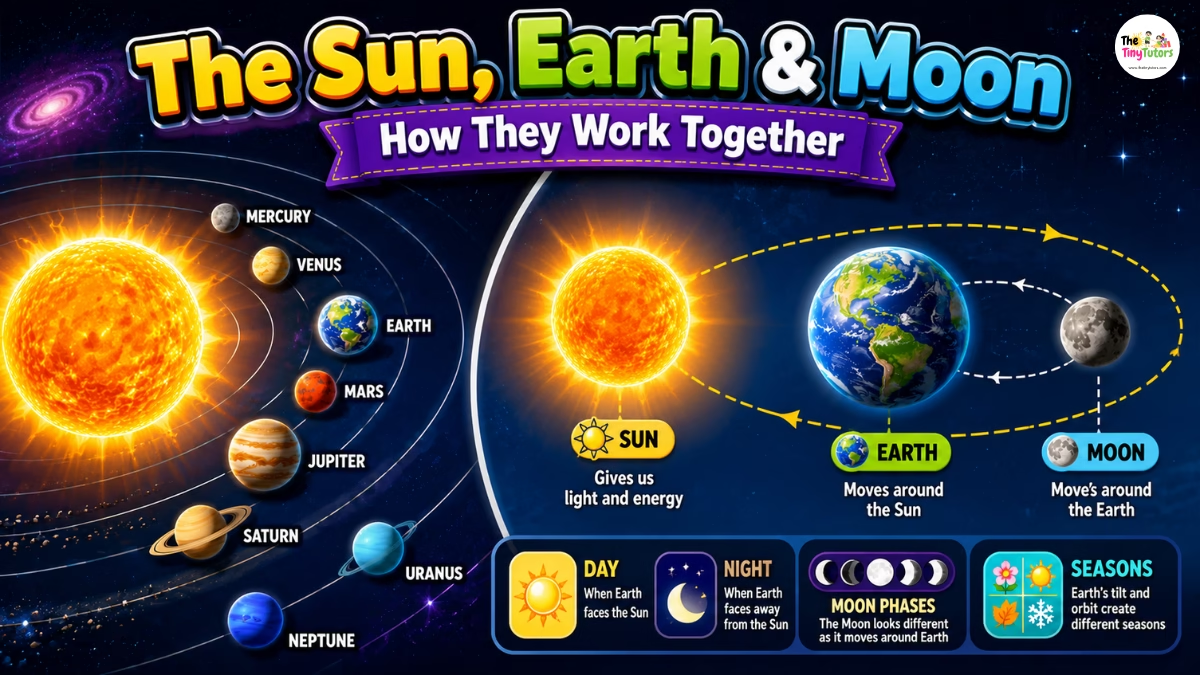
These planets include:
- Mercury
- Venus
- Earth
- Mars
- Jupiter
- Saturn
- Uranus
- Neptune
Because the Sun is so massive, its strong Gravity keeps every planet moving around it.
This is one of the most important solar system facts for kids because it explains why planets don’t float away into deep Space.
How the Sun, Earth and Moon Work Together
The Sun, Earth, and Moon work together like a wonderful team.
Here’s how:
☀️ The Sun gives light.
🌍 Earth travels around the Sun once every year.
🌙 The Moon travels around Earth about once every month.
The Moon does not make its own light.The Sun’s Position in Our Solar System
Instead, sunlight shines on the Moon, making it appear bright in the night sky.
These simple sun and earth facts help children understand why we have:
- 🌞 Day
- 🌜 Night
- 🌗 Moon phases
- 🌎 Seasons
Learning about the Sun, Earth, and Moon is one of the most exciting parts of Astronomy. You can also explore Moon Phases for Kids to understand why the Moon changes its shape throughout the month.
Why Is the Sun Important for Life on Earth?
The Sun is the main source of energy for our entire planet.
Without sunlight, Earth would become a dark, frozen world where plants, animals, and people could not survive.
If you’ve ever wondered why is the sun important, the answer is simple:
The Sun makes life possible.
Let’s see how.
The Sun Gives Us Light
Every morning, sunlight brightens our world.
Without sunlight:
- 🌍 Days would stay dark.
- 🚗 People couldn’t see clearly.
- 🌳 Plants couldn’t make food.
- 🐦 Many animals would struggle to survive.
These fascinating sunlight facts remind us how important daylight is for every living thing.
The Sun Gives Us Heat
The Sun also keeps our planet warm.
Its heat helps:
- People stay comfortable.
- Oceans remain liquid.
- Rivers continue flowing.
- Animals survive in many environments.
This natural warmth is one reason Earth can support life.
Understanding how does the sun help life on earth is one of the first lessons children learn in Science.
The Sun Helps Plants Grow
Plants use sunlight to make their own food through a process called photosynthesis.
Without sunlight:
- 🌱 Seeds would not grow.
- 🌳 Trees would not survive.
- 🍎 Fruits and vegetables would disappear.
Plants also produce oxygen, which people and animals need to breathe.
This makes the Sun one of nature’s greatest helpers.
The Sun Makes Weather Possible
The Sun warms land, oceans, and air.
This heating starts the water cycle, creates clouds, produces rain, and causes winds to blow.
Thanks to the Sun, we experience:
- ☀️ Sunny days
- 🌦️ Rainy days
- ❄️ Snow in winter
- 🌈 Beautiful rainbows
These amazing changes are part of Earth’s weather system.
These simple Sun Facts for Kids help children understand why the Sun is the most important natural source of life on our planet.
How Big Is the Sun?
Have you ever looked at the Sun and thought it was about the same size as the Moon? It may look small from Earth, but that’s only because it is very far away.
In reality, the Sun is the largest object in our Solar System. It is much bigger than every planet, including Earth.
The Sun has a diameter of about 1.39 million kilometers (864,000 miles). That means if you could line up more than 100 Earths side by side, they still would not be as wide as the Sun!
One of the most exciting Interesting Facts About the Sun is that almost everything in our Solar System revolves around this giant star because of its powerful Gravity.
Sun vs Earth Size Comparison
It can be difficult to imagine how huge the Sun really is, so let’s compare it with Earth.
| Feature | Sun | Earth |
|---|---|---|
| Type | Star | Planet |
| Diameter | About 1.39 million km | About 12,742 km |
| Size | Around 109 times wider than Earth | Much smaller |
| Makes its own light | ✅ Yes | ❌ No |
Although the Sun looks only a little bigger than the Moon in our sky, it is actually enormous. Its great distance makes it appear much smaller than it truly is.
How Many Earths Can Fit Inside the Sun?
This fact surprises almost everyone!
Scientists estimate that about 1.3 million Earths could fit inside the Sun if it were an empty ball.
Imagine filling a giant container with tiny blue marbles. In this example, the container is the Sun, and each marble is our beautiful planet Earth.
This comparison is one of the easiest ways for children to understand the incredible size of our nearest star.
How Far Is the Sun From Earth?
Even though the Sun seems close enough to warm your face, it is actually very far away.
The average distance between Earth and the Sun is about 150 million kilometers (93 million miles).
Scientists call this distance 1 Astronomical Unit (AU).
This perfect distance is one reason life can exist on Earth.
If our planet moved much closer, it would become far too hot.
If it moved much farther away, it would become too cold for most living things.
These amazing sun and earth facts show how perfectly our planet is placed in Space.
How Long Does Sunlight Take to Reach Earth?
Light travels incredibly fast—about 300,000 kilometers every second.
Even at this amazing speed, sunlight still takes about 8 minutes and 20 seconds to travel from the Sun to Earth.
That means whenever you look at the Sun, you are actually seeing it as it was a little more than eight minutes ago.
Isn’t that an amazing way to think about time and space?
How Hot Is the Sun?
The Sun is much hotter than anything we experience on Earth.
Its temperature is so high that no person, animal, or machine could safely stand on its surface.
Learning how hot is the sun helps children understand why it gives us both light and warmth.
Surface Temperature
The part of the Sun that we can see is called the Photosphere.
Its temperature is about 5,500°C (9,900°F).
Although this is called the “surface,” it is still made of glowing hot gas rather than solid ground.
The sunlight reaching Earth begins its journey from this bright outer layer.
Core Temperature
Deep inside the Sun is its center, called the Core.
The Core reaches an incredible temperature of about 15 million°C (27 million°F).
At this extreme heat, tiny Hydrogen atoms join together to form Helium.
This powerful process releases enormous amounts of energy every second.
It is the reason the Sun continues shining day after day.
How Old Is the Sun?
Scientists believe the Sun formed about 4.6 billion years ago.
That may sound like an impossible number to imagine!
The good news is that the Sun is expected to continue shining for another 5 billion years before it begins its final stages of life.
So children today—and many, many future generations—will continue enjoying sunny days for a very long time.
The Different Layers of the Sun
The Sun has six important layers, and each one helps produce light, heat, and energy. Learning these sun layers explained for kids makes sun science for kids simple and fun. Understanding the Sun’s layers is an important part of Sun Facts for Kids.
Core
The Core is the hottest part of the Sun. Here, Nuclear Fusion changes Hydrogen into Helium, creating the Sun’s energy.
Radiative Zone
The Radiative Zone carries energy away from the Core toward the outer layers.
Convective Zone
In the Convective Zone, hot gas rises and cool gas sinks, moving heat toward the surface.
Photosphere
The Photosphere is the bright surface we see from Earth, where sunlight begins its journey through Space.
Chromosphere
The Chromosphere is a thin layer above the Photosphere and can be seen during a total solar eclipse.
Corona
The Corona is the Sun’s outer atmosphere. It extends into the Solar System and sends out the Solar Wind.
How Does the Sun Produce Light and Heat?
The Sun doesn’t burn like wood or coal. Instead, it creates energy through an amazing natural process.
What Is Nuclear Fusion?
Inside the Sun’s Core, Hydrogen atoms are squeezed together by intense pressure and heat.
They combine to form Helium through a process called Nuclear Fusion.
During this process, a huge amount of energy is released as light and heat.
This energy travels outward through the Sun’s layers before reaching Earth as sunshine.
Without Nuclear Fusion, there would be no sunlight, no warm days, and no life on our planet.
What Are Sunspots and Solar Flares?
The Sun is always active.
Sometimes dark patches called Sunspots appear on its surface. These areas are cooler than the surrounding Photosphere but are still extremely hot.
The Sun can also produce powerful bursts of energy called Solar Flares.
These giant explosions send energy into Space and can sometimes affect satellites, radio signals, and even colorful auroras near Earth’s poles.
50 Amazing Sun Facts for Kids
Get ready to explore Sun Facts for Kids that are fun, easy to understand, and perfect for young learners.
These exciting facts will help you discover how our nearest Star works and why it is so important for life on Earth. Let’s enjoy these amazing Sun Facts for Kids together!
10 Interesting Facts About the Sun
Here are ten fascinating facts that every young space explorer should know.
- ☀️ The Sun is the only Star in our Solar System.
- 🌍 Earth travels around the Sun once every year.
- 🚀 Sunlight reaches Earth in about 8 minutes and 20 seconds.
- 🪐 The Sun’s Gravity keeps the planets in their Orbit.
- 🌱 Plants use sunlight to make food.
- 🌡️ The Sun is much hotter than Earth.
- 💡 The Sun creates its own light and heat.
- 🌊 The Sun helps drive Earth’s weather.
- 🌞 The Sun formed about 4.6 billion years ago.
- ⭐ Life on Earth depends on the Sun.
These are some of the most popular 10 Interesting Facts About the Sun that children often learn in school.
10 Interesting Facts About the Sun for Kids
Let’s explore another set of fun and easy facts!
- 🌟 The Sun looks white in space.
- 🔥 It is mostly made of Hydrogen and Helium.
- 🌎 About 1.3 million Earths could fit inside it.
- 🌻 Sunflowers often turn toward sunlight.
- 🌈 Sunlight creates rainbows.
- 🌕 The Moon reflects sunlight.
- 🦋 Many animals use sunlight to know day and night.
- 🐢 Sea turtles use sunlight to help find direction.
- 🌤️ The Sun helps create clouds and rain.
- 📚 Learning about the Sun is a great way to begin Astronomy.
These 10 Interesting Facts About the Sun for Kids make learning science simple and enjoyable.
Fun Facts About the Sun for Kids
Learning becomes even more exciting with these fun discoveries!
- 😄 The Sun is over one million times bigger than Earth by volume.
- 🚗 Driving to the Sun would take more than 100 years.
- 🛰️ Scientists study the Sun using spacecraft.
- 🎨 Sunlight contains all the colors of the rainbow.
- 🌅 Sunrise happens because Earth rotates.
- ❄️ The Sun shines even on cold days.
- 🦅 Many birds become active after sunrise.
- 🌺 Many flowers open in sunlight.
- ✨ Every second the Sun changes millions of tons of Hydrogen into Helium.
- ☄️ Scientists are still discovering new things about the Sun.
These exciting Sun Facts for Kids show that science can be both fun and educational.
10 Interesting Facts About the Sun for Students
Students often enjoy facts that connect classroom learning with real science.
📖 The Sun’s energy is produced through Nuclear Fusion.
📖 The Sun’s visible surface is called the Photosphere.
📖 Above the Photosphere are the Chromosphere and Corona.
📖 The Core is the hottest part of the Sun.
📖 Sunspots are cooler, darker areas on the Sun’s surface.
📖 Solar Flares are powerful bursts of energy from the Sun.
📖 The Sun contains about 99.8% of the Solar System’s total mass.
📖 Scientists measure the average Earth–Sun distance as 1 Astronomical Unit (AU).
📖 The Sun constantly releases tiny charged particles called the Solar Wind.
📖 The Sun is one of billions of stars in the Milky Way Galaxy.
These 10 Interesting Facts About the Sun for Students are perfect for science lessons and school presentations.
Amazing Sun Facts You Probably Didn’t Know
Here are a few bonus facts that surprise even many adults!
✨ Every second, the Sun changes about 600 million tons of Hydrogen into Helium.
✨ The Corona is much hotter than the Sun’s visible surface.
✨ Light created inside the Sun can take thousands of years to reach the surface.
✨ The Sun rotates, but different parts rotate at different speeds.
✨ Powerful solar storms can affect satellites and radio communication.
✨ The Sun travels around the center of the Milky Way Galaxy.
✨ One trip around the Milky Way takes the Sun about 225–250 million years.
✨ Scientists continue discovering new information about the Sun every year.
✨ The Sun is a medium-sized star, but many stars in the Universe are much larger.
✨ Every great journey into Science begins with curiosity—and learning about the Sun is a wonderful place to start.
Comparing the Sun with Earth and Other Stars
Comparing objects makes Sun Facts for Kids easier to understand. It helps children see the differences in size, light, and distance while learning more about our amazing Star and the Universe.
Sun vs Earth
| Feature | Sun | Earth |
|---|---|---|
| Type | Star | Planet |
| Produces Light | ✅ Yes | ❌ No |
| Produces Heat | ✅ Yes | ❌ No |
| Diameter | About 1.39 million km | About 12,742 km |
| Main Role | Gives light and energy | Supports life |
The Sun is about 109 times wider than Earth and provides the light and heat that make life possible on our planet.
Sun vs Moon
Although the Sun and Moon look similar in size from Earth, they are very different.
- ☀️ The Sun is a Star that produces its own light.
- 🌙 The Moon is much smaller and shines by reflecting sunlight.
Sun vs the Biggest Stars
Our Sun is a medium-sized Star, but some stars in the Universe are hundreds of times larger.
Even though it is not the biggest star, it is the perfect one for Earth because it provides the right amount of light and heat for life.
Comparing these objects is a fun way to learn Sun Facts for Kids and better understand our place in the Solar System.
Can Humans Visit or Live on the Sun?
The idea of visiting the Sun sounds exciting, but is it possible?
Can We Visit the Sun?
No spacecraft has landed on the Sun because it is far too hot.
However, scientists have sent spacecraft close to it to learn more about its heat, light, magnetic fields, and solar activity. These missions help us understand how the Sun works without putting people in danger.
Why Can’t Humans Live on the Sun?
Humans cannot live on the Sun because:
- 🔥 The temperature is far too high.
- 🌋 The Sun has no solid surface to stand on.
- 💨 It is made of extremely hot gases.
- ☢️ Intense radiation would make survival impossible.
Even the strongest materials created by humans would melt long before reaching the Sun.
What Would Happen If the Sun Disappeared?
This is a fun science question that helps us understand why the Sun is so important. Learning about these possibilities is another exciting part of Sun Facts for Kids.
If the Sun suddenly disappeared:
- 🌍 Earth would become dark after about 8 minutes.
- 🌡️ Temperatures would quickly begin to fall.
- 🌱 Plants could no longer make food.
- 🪐 The planets would leave their normal Orbit because the Sun’s Gravity would disappear.
Thankfully, this will not happen anytime soon. Scientists say the Sun will continue shining for billions of years, making Sun Facts for Kids even more amazing to explore.
Sun Safety Tips for Kids
The Sun is wonderful, but it is also important to enjoy it safely.
Protect Your Eyes from the Sun
😎 Never look directly at the Sun.
If you want to watch a solar eclipse, always use special eclipse glasses approved for safe viewing.
Wear Sunscreen Outdoors
🧴 Apply sunscreen before spending a long time outside.
It helps protect your skin from strong sunlight, especially during summer.
Stay Safe During Hot Weather
💧 Drink plenty of water.
🧢 Wear a hat with a wide brim.
👕 Choose light-colored clothing.
🌳 Take breaks in the shade when the weather is very hot.
These simple habits help children enjoy sunny days while staying healthy and safe.
Fun Sun Activities for Kids
Learning is more fun when children explore science through real-life activities. You can also try more kid-friendly space activities from NASA Space Place at home.
This simple activity helps children observe nature while learning Sun Facts for Kids in a safe and enjoyable way.
These hands-on experiences make Sun Facts for Kids easier to remember and encourage curiosity about the Solar System and Science.
Sun Observation Activity
Go outside with an adult on a sunny day and observe your surroundings.
Look for:
- ☀️ How warm does the sunlight feel?
- 🌳 Where do you see shadows?
- 🧭 Which direction is the Sun?
- 🐦 Are birds or insects active?
- 🌤️ How does the weather change during the day?
Important Safety Reminder
❌ Never look directly at the Sun.
✅ Observe the effects of sunlight, such as shadows, warmth, and changes in the sky, instead of looking at the Sun itself.
Frequently Asked Questions About the Sun
Parents and students often ask these questions while learning Sun Facts for Kids.
Q1: What Is the Sun?
The Sun is a giant star at the center of our Solar System. It provides the light and heat that make life possible on Earth.
Q2: Is the Sun a Star?
Yes. The Sun is a medium-sized star that creates its own light and energy.
Q3: How Old Is the Sun?
Scientists estimate that the Sun is about 4.6 billion years old and is expected to continue shining for another 5 billion years.
Q4: Why Is the Sun Hot?
The Sun is hot because Nuclear Fusion happens inside its Core. This process changes Hydrogen into Helium and releases enormous amounts of energy.
Q5: How Far Is the Sun From Earth?
Although the Sun lights up our sky every day, it is still about 150 million kilometers (93 million miles) away from Earth on average. This distance helps keep our planet at the right temperature for life.
Q6: How Does the Sun Help Plants?
Plants use sunlight to make their own food through photosynthesis. This helps them grow and produce oxygen for animals and people.
Q7: What Would Happen If the Sun Disappeared?
Earth would become dark after about eight minutes, temperatures would fall, and life would no longer be able to survive over time. Thankfully, scientists know the Sun will continue shining for billions of years.
Final Thoughts
The Sun is the heart of our Solar System, giving Earth the light, heat, and Solar Energy needed for life.
We hope these Sun Facts for Kids have helped you understand why our nearest Star is so important and made learning Sun Facts for Kids fun and easy.
Keep exploring Science, asking questions, and discovering more about Space and the amazing Universe—every new fact is the beginning of another exciting adventure!