
Have You Ever Wanted to Make It Rain Indoors? 🌧️
What if we told you that you could watch the water cycle happen right in your kitchen — with just a ziplock bag and some water? The best water cycle activity for kids does not need expensive equipment or a science lab. All it needs is a little curiosity and a sunny window!
- Have You Ever Wanted to Make It Rain Indoors? 🌧️
- What is the Water Cycle for Kids?
- Water Cycle Diagram for Kids 🗺️
- The 4 Main Stages of the Water Cycle
- Extra Stages of the Water Cycle 🌿
- 10 Best Water Cycle Activities for Kids 🎉
- Water Cycle Examples You See Every Day 👀
- Why is the Water Cycle Important? 🌏
- Amazing Water Cycle Facts for Kids 🤩
- Water Cycle Vocabulary Words 📖
- Water Cycle Quiz for Kids 🏆
- FAQs About the water cycle activity for kids❓
- Conclusion — You Are Now a Water Cycle Expert! 🎉
The water cycle is one of the most amazing processes on our planet. Water has been recycling itself for over 3 billion years — the same water that dinosaurs splashed in is still here today, moving through oceans, clouds, rivers, and rain. And the great news? You can see it, build it, and learn it through hands-on activities!
In this complete guide, you will find 10 exciting water cycle activities for kids — from simple classroom experiments to creative craft projects — along with a full explanation of how the water cycle works, a diagram, fun facts, vocabulary words, a quiz, and a free printable worksheet. This is your one-stop water cycle explained for kids!
What is the Water Cycle for Kids?
The water cycle (also called the hydrological cycle) is the continuous movement of water from the Earth’s surface up into the sky and back down again. Water never disappears — it just keeps changing its form and moving around our planet, forever.
Simple one-line definition: “The water cycle is nature’s way of recycling water — over and over again!”
| Age Group | Easy Explanation |
|---|---|
| Preschool / KG | 🌧️ Water goes up to the sky, makes clouds, and falls back as rain — then starts again! |
| Grade 1–2 | ☀️ The sun heats water, causing it to evaporate. The water vapor forms clouds through condensation and returns to Earth as precipitation (rain or snow). |
| Grade 3–5 | 🌎 The water cycle (hydrological cycle) includes evaporation, transpiration, condensation, precipitation, runoff, infiltration, and groundwater flow, which continuously recycle water on Earth. |
Water Cycle Diagram for Kids 🗺️
A clearly labeled diagram is one of the most powerful tools for understanding how the water cycle works. Before we dive into activities, take a moment to study the diagram below.
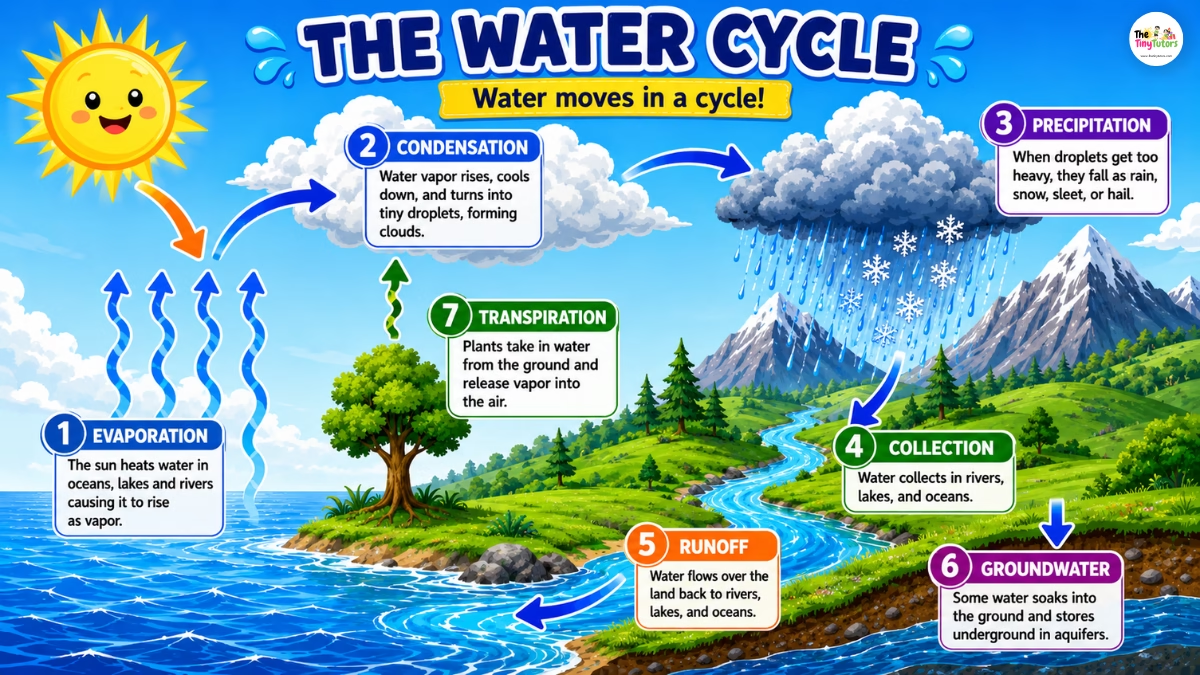
When you look at the water cycle diagram for kids, you will notice that water is always moving in a circle — which is exactly why it is called a “cycle”! The sun gives the energy to push water upward, and gravity pulls it back down. Together, they keep this process going 24 hours a day, 7 days a week, forever.
The 4 Main Stages of the Water Cycle
Every water cycle activity for kids teaches one or more of these four key stages. Understanding them makes every experiment and project much more meaningful!
☀️ 1: Evaporation
The sun heats water in oceans, lakes, and rivers. The water warms up and turns into an invisible gas called water vapor, which floats up into the sky.
⦁ The sun is the engine that powers the entire water cycle.
⦁ Water vapor is invisible — you cannot see it, but it is all around you!
⦁ Oceans provide about 86% of all the evaporation on Earth.
Real-life example: Wet clothes drying on a sunny day, or steam rising from a hot bowl of soup — that is evaporation in action!
☁️ 2: Condensation
As water vapor rises higher into the sky, it cools down. When it cools enough, it turns back into tiny liquid water droplets. Millions of these droplets join together to form clouds and fog.
⦁ This is condensation for kids explained simply: gas turns back to liquid when it cools.
⦁ Clouds are made of millions of tiny water droplets!
⦁ The higher you go, the colder the air — that is why clouds form up high.
Real-life example: Look at a cold glass on a warm day — water drops appear on the outside. That is condensation! Same with a foggy bathroom mirror after a hot shower.
🌧️ 3: Precipitation
Precipitation definition for kids: Precipitation is any form of water that falls from clouds to the Earth’s surface. When clouds become too heavy with water droplets, gravity pulls the water back down.
⦁ Rain falls when the air temperature is above 0°C (32°F).
⦁ Snow forms when water droplets freeze into ice crystals in very cold clouds.
⦁ Hail is balls of ice that form inside powerful thunderstorm clouds.
⦁ Sleet is a frozen mix of rain and snow — halfway between the two!
Real-life example: Next time it rains, remember: those drops traveled all the way from the ocean, up into the clouds, and back down to you!
🌊 4: Collection
After precipitation falls, water collects in oceans, rivers, lakes, and streams. Some water soaks into the ground and becomes groundwater. Then the whole cycle starts all over again!
⦁ About 71% of Earth’s surface is covered in water — there is a lot to collect!
⦁ Groundwater is stored underground in rock and soil.
⦁ Rivers carry water back to the ocean to restart the cycle.
Real-life example: Rain that falls in your garden runs into streams, which flow into rivers, which flow into the ocean — then evaporates again. Amazing!
Extra Stages of the Water Cycle 🌿
A complete water cycle explained for kids goes beyond the basic four stages. These extra stages are what makes the real water cycle in nature so fascinating!
🌱 Transpiration — Plants Sweat Too!
Did you know plants are secretly part of the water cycle? Transpiration is when plants absorb water through their roots and release water vapor through tiny holes in their leaves. A single large oak tree can release up to four hundred liters of water every day! Scientists call the combination of evaporation and transpiration “evapotranspiration.”
🏞️ Surface Runoff — Water on the Move
When heavy rain falls faster than the ground can absorb it, water flows across the surface into streams and rivers. This is runoff. During big storms, too much runoff can cause flooding — which is why planting trees and plants helps slow the water down.
💧 Infiltration — Water Goes Underground
Some rainwater soaks slowly into soil and travels underground. This is infiltration. It gets stored in layers of rock called aquifers — a natural underground water tank that supplies clean drinking water to millions of people.
🪨 Groundwater — Hidden Water Beneath Your Feet
Groundwater is water stored underground in spaces between rocks and soil. It moves very slowly and can stay underground for hundreds or even thousands of years before returning to the surface through springs or wells.
10 Best Water Cycle Activities for Kids 🎉
This is the main section of our guide! Each water cycle activity for kids below is designed to make science simple, fun, and easy to understand.
1: Ziplock Bag Experiment 🧪 (Best Indoor Water Cycle Activity for Kids)
This is the most popular water cycle activity for kids and our absolute favourite! You can do it at home with just 4 things.
| 🛒 What You Need: | 👣 Steps: |
|---|---|
| clear ziplock bag (medium or large) | 1. Draw clouds at the top and waves at the bottom with marker. |
| Water (about 1/4 cup) | 2. Pour water (+ food coloring) into the bag and seal tightly. |
| Blue food coloring (optional!) | 3. Tape the bag to a sunny window. |
| A permanent marker | 4. Wait 2–4 hours and watch what happens. |
| Sticky tape | 5. Drops form at the top and run down — showing condensation and precipitation. |
🔬 What Is Happening?
Sun heats the water → evaporates → vapor condenses on the cool top of the bag → droplets drip down. You are watching a mini water cycle in action!
2: Cloud in a Jar Experiment ☁️ (Easy STEM Activity)
This stunning water cycle activity for kids actually makes a real cloud appear inside a glass jar! It is a brilliant STEM activity for Grade 2 and Grade 3.
What You Need: Glass jar, hot water, plate or lid, ice cubes, hairspray.
Steps:
- Pour 2–3 cm of hot water into the jar.
- Cover with the plate and place ice cubes on top.
- Quickly lift the lid, spray a tiny amount of hairspray inside, replace the lid.
- Watch a cloud appear in seconds!
Why it works: Hot water evaporates, rises, hits the cold air from the ice, and condenses around the hairspray particles — exactly how real clouds form in the sky!
3: Make a Rain Gauge 📏 (Outdoor Water Cycle Project for Kids)
Scientists use rain gauges to measure precipitation. Now kids can build one too!
What You Need: Plastic bottle, ruler, tape, marker, soil or sand.
Steps:
- Cut the top off the bottle and flip it inside the bottom half as a funnel.
- Mark measurement lines up the side with the ruler and marker.
- Bury the base in garden soil so it stays upright.
- After rain, record the millimeters in a notebook daily for one week.
Science link: Every drop collected came from evaporation somewhere in the world — precipitation in action!
4: Water Cycle Wheel Craft 🎡 (Best Craft Activity)
The water cycle wheel is a brilliant water cycle activity for kids that helps children remember all four stages visually. It is one of the best water cycle activities for kindergarten too!
What you need:
⦁ Two paper plates, a brass fastener, scissors, coloring pencils, markers.
⦁ On the bottom plate, draw and label the 4 stages: Evaporation, Condensation, Precipitation, Collection.
⦁ Cut a quarter-section window in the top plate.
⦁ Join both plates with the brass fastener through the centre.
⦁ Spin the wheel to reveal each stage. Write one sentence about each stage as it appears.
Learning goal: Kids physically spin through the water cycle, reinforcing the idea that it is a continuous loop — never stopping!
5: Cotton Cloud Craft 🌥️ (Fun Classroom Activity)
This is one of the most popular water cycle classroom activities for kids! It is simple enough for preschoolers and educational enough for Grade 3.
What you need:
⦁ Blue card or paper, cotton balls, glue, watercolor paint or blue paint, raindrop shapes cut from paper.
⦁ Paint the blue card to look like a sky.
⦁ Glue cotton balls at the top to make clouds. Pull them apart to make them fluffy!
⦁ Hang blue raindrop cutouts below the clouds with thread.
⦁ Below the rain, draw or glue a sun and waves for the ocean — and add arrows showing the water cycle direction.
Classroom tip: Create one giant class display on the wall. Each child can add their own rain cloud!
6: Water Cycle Coloring Activity 🖍️ (Perfect for Preschool & KG)
A water cycle coloring activity is one of the easiest and most enjoyable ways for young children to learn how water moves around our planet. Coloring and simple worksheets help kids recognize the different parts of the water cycle while having fun.
This creative water cycle activity for kids is especially popular with preschoolers and early learners.
🖍️ Free Printable Worksheets: Explore our free printable worksheets and activities designed for preschool and early elementary learners. These kid-friendly pages are great for home or classroom use and support early science learning in a fun way.
7: DIY Water Cycle Model 🏔️ (Amazing STEM Project for Kids)
This water cycle project for kids creates a 3D landscape inside a clear plastic container — a real working water cycle model you can watch for days! It is one of the most exciting water cycle activities for kids who love building things and exploring STEM concepts.
What you need:
⦁ A large clear plastic box with lid, soil, rocks, small plants (or grass seeds), water.
⦁ On one side of the box, build up soil and rocks to create a mountain or hill shape.
⦁ Leave the other side flat and fill it with water to represent the ocean.
⦁ Plant small grass seeds or tiny plants on the hill.
⦁ Close the lid tightly and place in sunlight.
⦁ Over the next few days, watch condensation form on the lid and drip back down as “rain”!
What you will see: Evaporation from the water → condensation on the lid → precipitation dripping back to the soil → plants absorbing water through roots (transpiration!). All four stages — plus transpiration — in one box!
8: Water Cycle Song & Rhyme 🎵 (Fun Learning Activity)
Music is one of the most powerful tools for helping kids memorize new information. Singing a water cycle song is one of the best water cycle activities for kids who love movement and music — and it works for every grade from KG to Grade 3!
🎵 The Water Cycle Song (Sing to any simple tune!)
“The sun shines down and warms the sea,
Water vapor rises, up so free! (Evaporation!)
Clouds form up high, all cool and white,
Condensation happening — what a sight!
Rain comes down and hits the ground,
Precipitation — hear that sound!
Water flows to rivers and the sea,
Collection done — now repeat with me!”
Teachers: Write each stage word on the board and point to it as kids sing. Parents: Sing it in the car or at bathtime — kids will remember the stages in no time!
9: Water Cycle Board Game 🎲 (Interactive Classroom Game)
This water cycle game turns learning into playtime! It is one of the most engaging water cycle activities for the classroom and works brilliantly for pairs or small groups.
How to make it:
1. Draw a winding path on a large sheet of card with 20–30 spaces.
2. Label spaces with water cycle events: “Evaporate! Move forward 3.” / “Heavy rain! Move back 2.” / “Groundwater! Skip a turn.” / “Transpiration! Roll again.”
3. Make question cards: “Name the 4 stages.” / “What is precipitation?” / “Define condensation for kids.”
4. Use a dice and small tokens (coins or buttons work perfectly!).
5. First player to complete the full water cycle wins!
10: Printable Water Cycle Worksheet Activity 📄
A printable worksheet is one of the most practical water cycle activity for kids — it can be used at home, in the classroom, or as a homework assignment. Our FREE Water Cycle Worksheet covers all the key stages in a fun, kid-friendly format.
| 📄 Free Printable Activities | 🎯 Best For |
|---|---|
| 🖍️ Coloring Pages & Creative Fun | Preschool & Kindergarten |
| ✏️ Fill-in-the-Blanks Practice | Grade 2–3 |
| 🔗 Matching and Sorting Activities | Preschool to Grade 1 |
| ✅ True or False Quiz | All Ages |
| 🏠 Printable Learning Pages | Home & Classroom Use |
Water Cycle Examples You See Every Day 👀
The water cycle is happening all around you — every single day!
| What You See | Stage | What Is Happening |
|---|---|---|
| Steam from hot soup | Evaporation | Heat turns liquid water into invisible vapor |
| Morning dew on grass | Condensation | Cool night air condenses into water drops on leaves |
| Drops on a cold drink glass | Condensation | Warm air around the cold glass cools and forms drops |
| Rain falling outside | Precipitation | Clouds release water back to Earth |
| River flowing after heavy rain | Collection | Water gathers and moves back toward the ocean |
Why is the Water Cycle Important? 🌏
Every water cycle activity for kids teaches a deeper lesson — without the water cycle, life on Earth would simply not exist. Here is why it matters so much:
| Why It Matters | Explanation |
|---|---|
| 🌱 Plants grow | Plants need water for photosynthesis. The water cycle delivers fresh water to plants through rain. See our Food Chain for Kids post to learn how plants feed everything! |
| 🐘 Animals survive | Every animal — from tiny insects to giant elephants — needs fresh water to survive. |
| 🚰 Humans drink | The water cycle supplies fresh water to rivers, lakes, and aquifers — our main sources of drinking water. Learn more in our Digestive System for Kids post! |
| 🌦️ Weather forms | Rain, snow, storms — all weather is driven by the water cycle. Without it, there would be no weather at all! |
| 🌡️ Earth stays cool | Evaporation cools the Earth’s surface — just like sweat cools your body. Without it, Earth would be dangerously hot. |
| ♻️ Water stays clean | The water cycle naturally filters water as it moves through soil and rock, keeping it clean for all living things. |
Amazing Water Cycle Facts for Kids 🤩
Besides experiments and crafts, a water cycle activity for kids can also include songs, games, and fun facts that make science easier to remember.
💧 Fact 1 — Dinosaur Water!
The Earth has had the same amount of water for over 3 billion years. The water you drink today could be the very same water a T-Rex splashed in millions of years ago!
☁️ Fact 2 — Clouds Are Heavy!
A single fluffy cloud can weigh over 500,000 kilograms — heavier than a jumbo jet! Yet it floats because the droplets are spread across a huge volume of light air.
🌊 Fact 3 — Most Water Is Salty!
About 71% of Earth’s surface is covered by water — but only 3% is fresh water. Most of that is frozen in glaciers and ice caps!
🌧️ Fact 4 — Fast Traveller!
On average, a water molecule spends about 9 days in the atmosphere before falling back to Earth as rain or snow.
🌱 Fact 5 — Sweaty Trees!
A large oak tree releases about 400 litres of water through transpiration every single day. Forests act like giant natural humidifiers for the planet!
💨 Fact 6 — Water Vapor Power!
Water vapor makes up only 1–4% of the atmosphere — but it is the most powerful greenhouse gas, even more impactful than carbon dioxide!
Water Cycle Vocabulary Words 📖
After completing a water cycle activity for kids, learning these science words becomes much easier and more meaningful.
| Word | What It Means |
|---|---|
| Evaporation | When the sun heats water, it turns into an invisible gas called water vapor and rises into the sky. |
| Condensation | Water vapor cools in the sky and turns back into tiny liquid droplets, forming clouds. |
| Precipitation | Any water that falls from clouds to Earth — rain, snow, sleet, or hail. |
| Collection | Water that gathers in oceans, rivers, and lakes after precipitation falls. |
| Transpiration | Plants release water vapor through tiny holes in their leaves into the air. |
| Runoff | Rainwater that flows across the ground into streams and rivers. |
| Water Vapor | The invisible gas form of water that floats in the air around us. |
Water Cycle Quiz for Kids 🏆
After completing a water cycle activity for kids, challenge yourself with this fun quiz to see how much you remember.
Q1. What stage of the water cycle forms clouds?
A) Evaporation
B) Condensation ✅
C) Collection
D) Runoff
Q2. What gives energy to the water cycle?
A) The Moon
B) Wind
C) The Sun ✅
D) Gravity
Q3. Rain, snow, sleet, and hail are all examples of?
A) Evaporation
B) Transpiration
C) Precipitation ✅
D) Infiltration
Q4. What do plants release that adds to the water cycle?
A) Carbon Dioxide
B) Oxygen
C) Water vapor through Transpiration ✅
D) Nitrogen
Q5. Water soaking into the ground is called?
A) Runoff
B) Infiltration ✅
C) Condensation
D) Evaporation
Q6. True or False: The Earth creates new water regularly.
❌ FALSE — Earth has had the same water for over 3 billion years. It just keeps recycling!
FAQs About the water cycle activity for kids❓
Here are the most common questions parents, teachers, and kids ask about the water cycle:
What are the 4 stages of the water cycle?
The four main stages are: (1) Evaporation — water heats and becomes vapor; (2) Condensation — vapor cools and forms clouds; (3) Precipitation — water falls as rain, snow, or hail; (4) Collection — water gathers in oceans, rivers, and underground.
What is evaporation for kids?
Evaporation for kids means: when the sun heats water in a puddle, river, or ocean, the water turns into an invisible gas called water vapor and floats up into the sky. You can see it happening when wet clothes dry or steam rises from hot soup!
What is condensation for kids?
Condensation for kids means: when warm water vapor rises into the cooler sky, it cools down and turns back into tiny liquid water droplets. Millions of droplets join together to form clouds. You can see condensation on a cold glass or a foggy mirror.
What are easy water cycle activities for kindergarten?
The easiest water cycle activities for kindergarten include: (1) the Ziplock Bag Experiment — tape water in a bag to a sunny window and watch the rain form inside; (2) Cotton Cloud Craft — glue cotton balls to card as clouds with raindrop cutouts below; (3) Water Cycle Coloring Activity — colour and label a diagram of all four stages.
What is a good water cycle project for kids?
The best water cycle project for kids is the DIY Water Cycle Model (a working 3D terrarium inside a clear box) or the Rain Gauge Project. Both are excellent school projects that demonstrate evaporation, condensation, precipitation, and collection in a visual, hands-on way.
What are water cycle activities for kids?
A water cycle activity for kids is any hands-on experiment, craft, game, or project that helps children understand how water moves around Earth.
Conclusion — You Are Now a Water Cycle Expert! 🎉
The water cycle is one of Earth’s most incredible systems — and now you truly understand how it works! From evaporation to collection, every stage plays a vital role in keeping our planet alive.
Pick any water cycle activity for kids from this guide — the Ziplock Bag Experiment, Cloud in a Jar, or the DIY Water Cycle Model — and watch the science come to life right in front of you.
No matter which water cycle activity for kids you choose, hands-on learning makes science more exciting and memorable.
Next time it rains, remember: those drops may have started their journey in a faraway ocean. How amazing is that? 💧