
Constellations for Kids can turn a simple look at the night sky into a science adventure. ✨ Children can learn to notice star patterns, ask questions, and understand why the sky looks different from place to place.
- What Is a Constellation?
- How Do Constellations Work?
- Famous Constellations Kids Can Learn
- Constellation vs. Asterism: What’s the Difference?
- How to Find a Constellation in the Night Sky
- Can You See the Same Constellations Everywhere?
- Why Are Constellations Important?
- Constellations in Different Cultures
- Easy Constellation Activities for Kids
- Frequently Asked Questions
- Key Takeaways
This guide is written for ages 5–12, parents, teachers, and homeschooling families. It explains what is a constellation of stars in clear language and gives children safe, practical ways to explore the sky.
🌟 Quick fact: For Constellations for Kids, modern astronomy recognizes 88 official constellations.
What Is a Constellation?
Constellations for Kids are easiest to understand when children imagine the night sky as a giant map. A constellation is a named region of the sky. From Earth, stars in that region may appear to form a familiar shape or pattern.
For a kid-friendly introduction to star patterns and constellations, NASA Space Place also explains how people recognize constellations in the night sky.
Simple Definition for Kids
For young learners, a simple answer to what is a constellation is: a named area of the sky that helps people recognize and locate objects in space. ⭐ Lines between stars are only visual guides.
The International Astronomical Union explains that modern constellations are defined areas of the sky, even though people historically imagined many of them as pictures or patterns.
How Stars Appear to Make Patterns
Our viewpoint from Earth makes some stars look close together. Imagine several stickers placed at different distances on a large wall.
From one position, those stickers might appear to make a picture. Stars can work in a similar way: their apparent positions create patterns that our brains can recognize.
Are Stars in the Same Constellation Really Close to Each Other?
Usually, no. Stars that appear side by side can be separated by large distances. One useful Constellations for Kids fact is that a sky pattern describes how stars look from Earth, not necessarily how close they are in space. These are important constellation facts for kids to remember.
🌟 Think about it: If you could fly far away from Earth, the same stars might not look like the same pattern!
How Do Constellations Work?
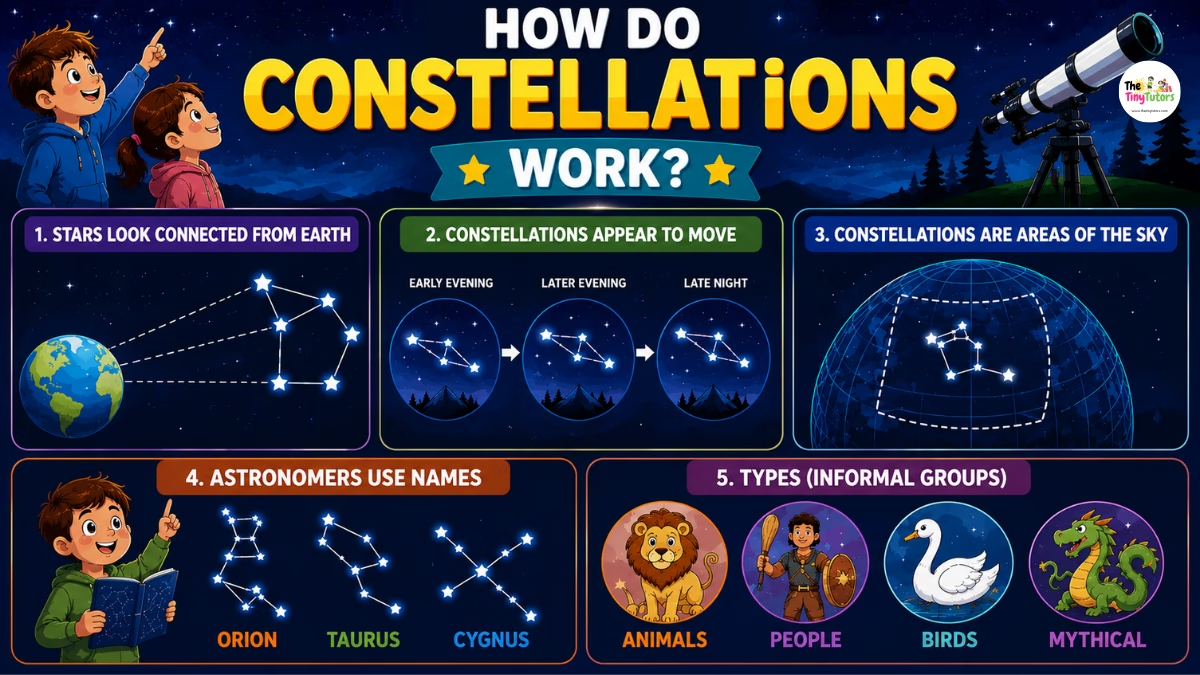
Constellations for Kids become clearer when children learn that a constellation is both a recognizable pattern and an official region of the sky.
Why Stars Look Connected From Earth
Stars are at different distances from us. From our viewpoint, they create recognizable shapes.
The lines you see on many star maps are simply there to help our eyes recognize a pattern. The stars themselves are not physically connected by those lines.
Why Do Star Patterns Look Different as the Night Goes On?
If you watch the night sky for a few hours, you may notice that constellations seem to move from one part of the sky to another. 🌌
This happens mainly because Earth rotates on its axis. As Earth spins, the part of the sky we face changes, making stars and constellations appear to move across the sky.
For example, a constellation may appear near the eastern horizon earlier in the evening and be higher in the sky later. Some stars may eventually move toward the western horizon and disappear from view.
⭐ Try this: Look at the same constellation at the beginning and end of an evening. Its position may look different even though the stars themselves have not suddenly moved across space.
Constellations as Areas of the Night Sky
These defined regions give astronomers a consistent way to describe where objects appear in the sky.
This is why a constellation is more than just a picture. It works somewhat like an address in the sky.
How Astronomers Use Constellation Names
Learning constellation names for kids gives children useful astronomy vocabulary. Names such as Orion, Taurus, and Cygnus help skywatchers talk about different parts of the night sky.
For example, instead of saying “that bright star near the swan-shaped pattern,” someone can use the constellation’s name to describe the area more clearly.
What Are the “Types of Constellations”?
You may sometimes see constellations grouped informally into categories such as animal constellations, people or characters, and objects or mythical creatures. These are helpful learning groups, but they are not official scientific types of constellations.
For example:
- 🦁 Animals: Leo represents a lion, while Taurus represents a bull.
- 🦢 Birds: Cygnus is associated with a swan.
- 👤 People or characters: Orion and Cassiopeia are named figures from traditional sky stories.
- 🐉 Mythical creatures: Draco is traditionally represented as a dragon.
These groups are simply a fun way for children to organize constellation names in their minds. Astronomers do not classify the 88 official constellations into these categories as a scientific system.
🌟 Remember: A constellation is officially a region of the sky, even though people may also recognize a memorable picture or story within that region.
Famous Constellations Kids Can Learn
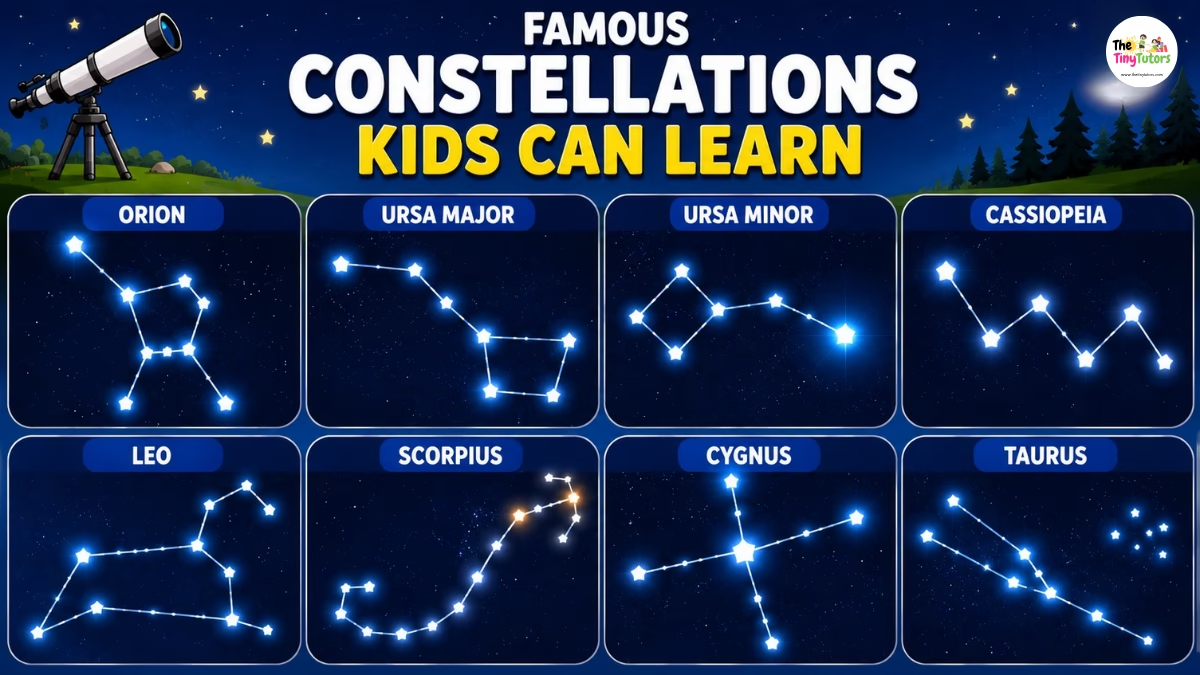
For young learners, it is better to start with a few famous constellations for kids rather than trying to memorize all 88.
| Constellation | Easy clue | Kid-friendly fact |
|---|---|---|
| Orion | Three bright stars form Orion’s Belt | A familiar pattern for many skywatchers |
| Ursa Major | Look for the Big Dipper | The Big Dipper is an asterism inside it |
| Ursa Minor | Look for the Little Dipper | Polaris is part of this constellation |
| Cassiopeia | Looks like W or M | Its shape appears to turn as it moves across the sky |
| Leo | Think of a lion | Its name means “lion” |
| Scorpius | Curved, scorpion-like shape | Easier to recognize from many southern locations |
| Cygnus | Think of a swan | Deneb is one of its bright stars |
| Taurus | Imagine a bull | The Pleiades star cluster is in Taurus |
🌟 Bonus fact: A common question is, what is the largest constellation in the night sky? Hydra is the largest constellation in the sky by area, covering about 1,303 square degrees. It does not look biggest to your eyes.
A Fun Way to Learn the Patterns
Instead of asking children to memorize constellation names, encourage them to notice a simple shape or visual clue.
For example, children can look for a lion-like outline in Leo or a curved shape in Scorpius.
This makes star learning more visual and easier to remember. 🌟
Constellation vs. Asterism: What’s the Difference?
Constellations for Kids should include one important distinction: a constellation and an asterism are not the same thing.
What Is an Asterism?
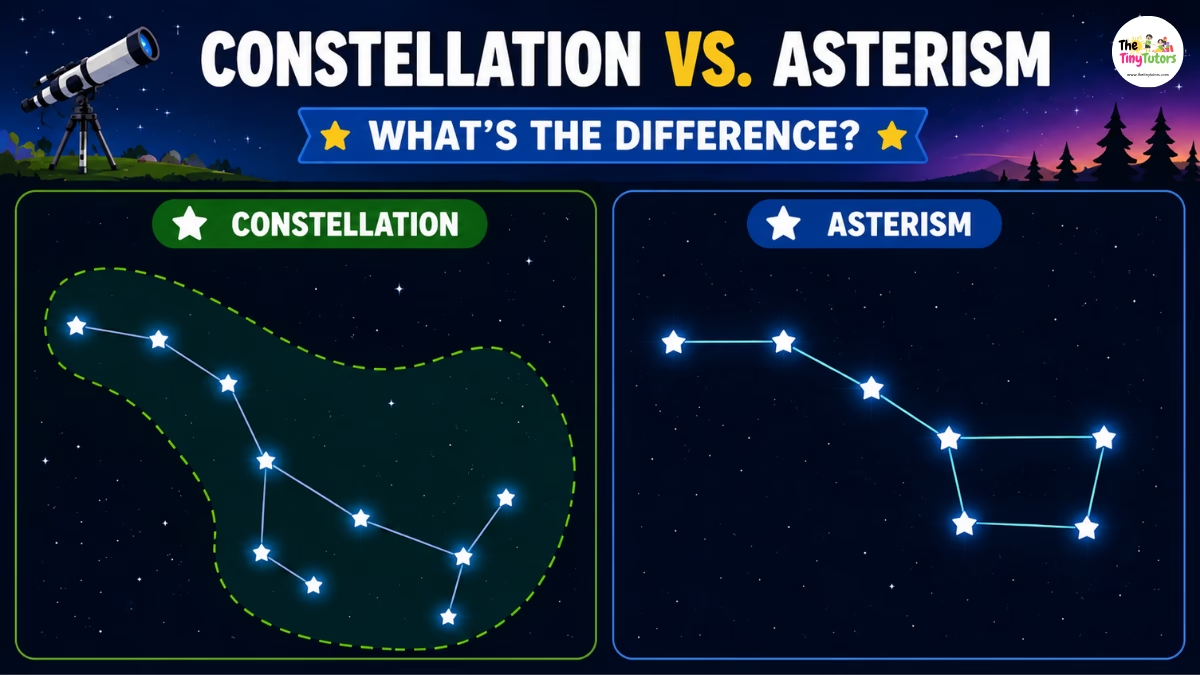
An asterism is a recognizable star pattern that is not one of the 88 official constellation regions. Some asterisms sit inside one constellation, while others can use stars from more than one.
NASA gives familiar examples such as the Big Dipper and Summer Triangle.
Why the Big Dipper Is Not a Constellation
The difference between an asterism and a constellation is simple: an asterism is a star pattern, while a constellation is an official sky region.
The Big Dipper is an asterism. Its familiar seven-star shape is part of the larger constellation Ursa Major.
Big Dipper and Ursa Major Explained Simply
Think of Ursa Major as a large sky neighborhood and the Big Dipper as a recognizable shape inside it. 🥣
So, what constellation is the Big Dipper a part of? The answer is Ursa Major.
How to Find a Constellation in the Night Sky
Looking for a real constellation turns this lesson into a mini sky investigation. 🌠 Children can use a simple star chart, observe one pattern, and record what they notice.
- Choose a clear, dark location. Bright city lights can hide faint stars.
- Start with an easy constellation. Choose a pattern that is visible from your location and season.
- Use a star chart or sky map. Compare the map with the sky.
- Follow bright or easy-to-recognize stars. Look for the overall shape first.
- Check direction, season, and time. The visible sky changes throughout the year.
👀 Sky tip: Let your eyes adjust to the darkness and keep bright phone screens away while searching.
You don’t need special equipment to begin skywatching. NASA’s beginner-friendly Skywatching FAQ explains simple ways to start observing the night sky.
Can You See the Same Constellations Everywhere?
Constellations for Kids are a great way to learn that Earth’s location changes our view of space.
Why Location Matters
Earth is round, so people in different places see different parts of the sky. Some constellations may be visible from both places, while others may not rise above the horizon.
Northern and Southern Hemisphere
The Northern and Southern Hemispheres have different views of the night sky. Some constellations are especially associated with one hemisphere.
This is why a child in India, Canada, Australia, or Brazil may not see exactly the same constellations at the same time.
Why the Visible Sky Changes During the Year
Earth travels around the Sun. As its position changes, the nighttime side of Earth faces different directions in space. That is why different constellations become easier to see during different seasons.
Why Are Constellations Important?
Constellations are more than pretty star shapes. They show how people have used the sky for practical and cultural reasons.
- 🧭 Navigation: Stars helped travelers and sailors find directions.
- 📅 Seasons and calendars: Repeated sky patterns helped people notice seasonal changes.
- 🔭 Astronomy: Official constellation regions help astronomers describe locations in the sky.
Children who enjoy exploring the night sky can also learn about the planets in our Solar System with this simple Planet Names for Kids guide.
- 📖 Stories and traditions: Many cultures created stories and meanings around the stars.
NASA notes that recognizable stars and constellations have been used for navigation, including celestial navigation.
Constellations in Different Cultures
Constellations for Kids can introduce children to world cultures. People around the world have looked at many of the same stars but have not always imagined the same pictures.
A group of stars that represents a bear in one tradition may have a different meaning elsewhere. Greek and Roman constellation stories are well known, but they are only part of the much wider history of sky traditions.
The IAU also notes that many cultures have developed their own star patterns and traditions, including Indigenous and historical sky traditions.
Ask: What did this culture see in the stars, and why was it important? 🌍
This encourages children to learn astronomy while respecting different cultures and their histories.
Easy Constellation Activities for Kids
Hands-on constellation activities for kids make Constellations for Kids astronomy easier to remember.
⭐ Connect-the-Stars
Draw random dots on paper. Let children connect them into an animal, object, or imaginary creature, then give the new pattern a name.
🔦 Make a Constellation Viewer
With adult help, punch small star shapes into dark paper and place it over a flashlight opening. Shine the light toward a wall to make a simple pattern.
🎨 Create Your Own Constellation
Ask children to draw a sky character using stars as dots. Write a short story explaining its name.
📓 Keep a Night-Sky Journal
Record the date, time, location, weather, and pattern seen. Add a quick drawing. This turns skywatching into science. 🌙 Children can also use the same observation habit to track the Moon with our Moon Phases for Kids guide.
🧩 Play a Matching Game
Match a name with its clue:
Orion → Belt
Cassiopeia → W shape
Ursa Major → Big Dipper
These can also become easy constellation crafts for kids using paper, cardboard, pencils, and recycled materials.
Frequently Asked Questions
Q1: What Is a Constellation in Simple Words?
It is a named area of the sky that helps people identify and describe where objects appear.
Q2: How Many Constellations Are There?
There are 88 officially recognized constellations in modern astronomy.
Q3: Are the Stars in a Constellation Actually Close Together?
Not necessarily. Stars that look close together can be separated by large distances.
Q4: Is the Big Dipper a Constellation?
No. The Big Dipper is an asterism within the constellation Ursa Major.
Q5: Can You See the Same Constellations Everywhere?
No. What you can see depends on your location, latitude, season, and time of night.
Q6: Can Kids See Constellations Without a Telescope?
Yes. Many bright stars and recognizable patterns can be seen with the unaided eye from a suitable dark location. A telescope is not required to begin skywatching.
Key Takeaways
Learning about constellations is an easy doorway into astronomy. Children can remember three ideas:
- 🌟 A constellation is a named region of the sky.
- 🌍 Location, season, and time affect what we can see.
- 🔭 You do not need a telescope to start exploring.
Constellations for Kids become even more exciting when learning turns into observation. On the next clear evening, step outside with a sky map, find one pattern, and ask one new question.